
Heavy Equipment Buyer’s Guide
Industrial Heavy Transporters: How to Compare, Cost, and Choose
The honest guide to 40 to 400-ton in-plant transporters. A straight KAMAG vs Cometto vs Kress comparison, every subtype explained, real cost context, and where an SPMT is the wrong tool.
40 to 400 tons
Standard payload range of the class
4 builders
KAMAG, Cometto, Kress, Paling compared
Brand-independent
Honest comparison, no OEM bias
Updated August 2026
An industrial heavy transporter moves the loads inside a plant that nothing else can: slabs, coils, billets, dies, and scrap pallets from 40 to 400 tons, lifted and carried without a crane. It is also one of the most opaque machine classes to buy, with no published pricing and a vocabulary that changes from one mill to the next. This guide gives you the straight answers: how KAMAG, Cometto, and Kress compare, what the subtypes actually do, what they cost, how the builders compare, and when a rented SPMT or a heavy forklift is the better tool. We service this class regardless of brand, so we have no reason to tell you anything but the truth about all of them.
Bulk Equipment Corp. is a brand-independent heavy-equipment uptime partner with shops in Michigan City, Indiana and Memphis, Tennessee, serving steel mills, scrap yards, ports, and intermodal terminals across the United States. We service and manage fleets for every major heavy equipment brand.
The Short Version
- An industrial heavy transporter carries 40 to 400 ton loads across a plant on an elevating deck, with no crane in the loop.
- The North American field is TII KAMAG, Cometto, Kress, and Paling. KAMAG runs the broadest standardized series line in the class.
- Pricing starts at approximately $750,000 for a base machine and runs to roughly $3.25 million or more fully configured, before tariffs and shipping.
- It is not an SPMT. An SPMT is modular, remote-operated, and rented for one-time project moves; a transporter is a single-chassis machine bought for daily in-plant work.
- Parts lead time and local service decide your real cost per move more than the badge does.
The CategoryWhat Is an Industrial Heavy Transporter?
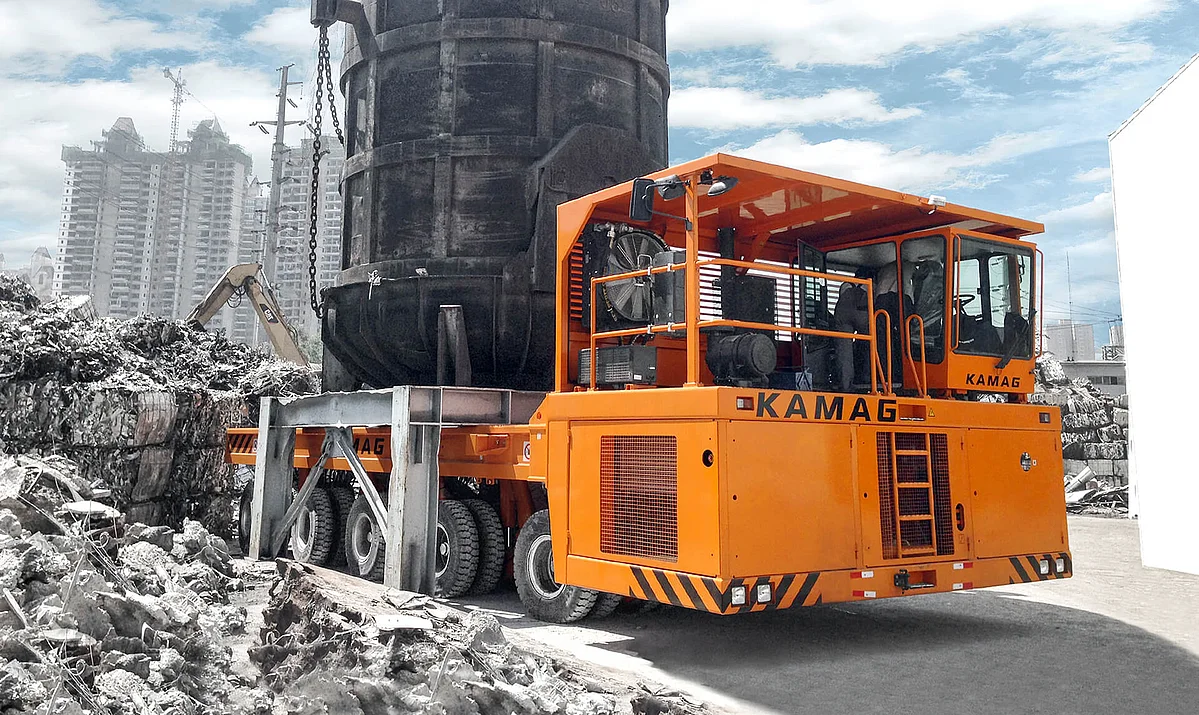
An industrial heavy transporter is a self-propelled, single-chassis vehicle with an elevating deck: it drives under a loaded pallet or stillage, lifts it hydraulically, carries it anywhere in the plant, and sets it down. No crane, no transfer stand, no rigging. The same machine class goes by several names depending on who you ask: lift transporter, industrial elevating transporter, elevating platform transporter, or simply self-propelled transporter. Whatever the name, the job is the same: break the plant’s dependence on overhead cranes for horizontal moves.
| Payload class | Typical loads | Typical work |
|---|---|---|
| 20 to 60 tons | Coils, dies and molds, billets | Coil yards, stamping and casting plants, service centers |
| 60 to 150 tons | Slabs, large coils, long products | Slab yards, rolling mills, plate and pipe operations |
| 100 to 250 tons | Scrap pallets and baskets, ladle pallets | EAF charge logistics, melt shop supply |
| 250 to 500+ tons | Molten-metal pallets, special heavy loads | Custom-engineered units for the heaviest furnace logistics |
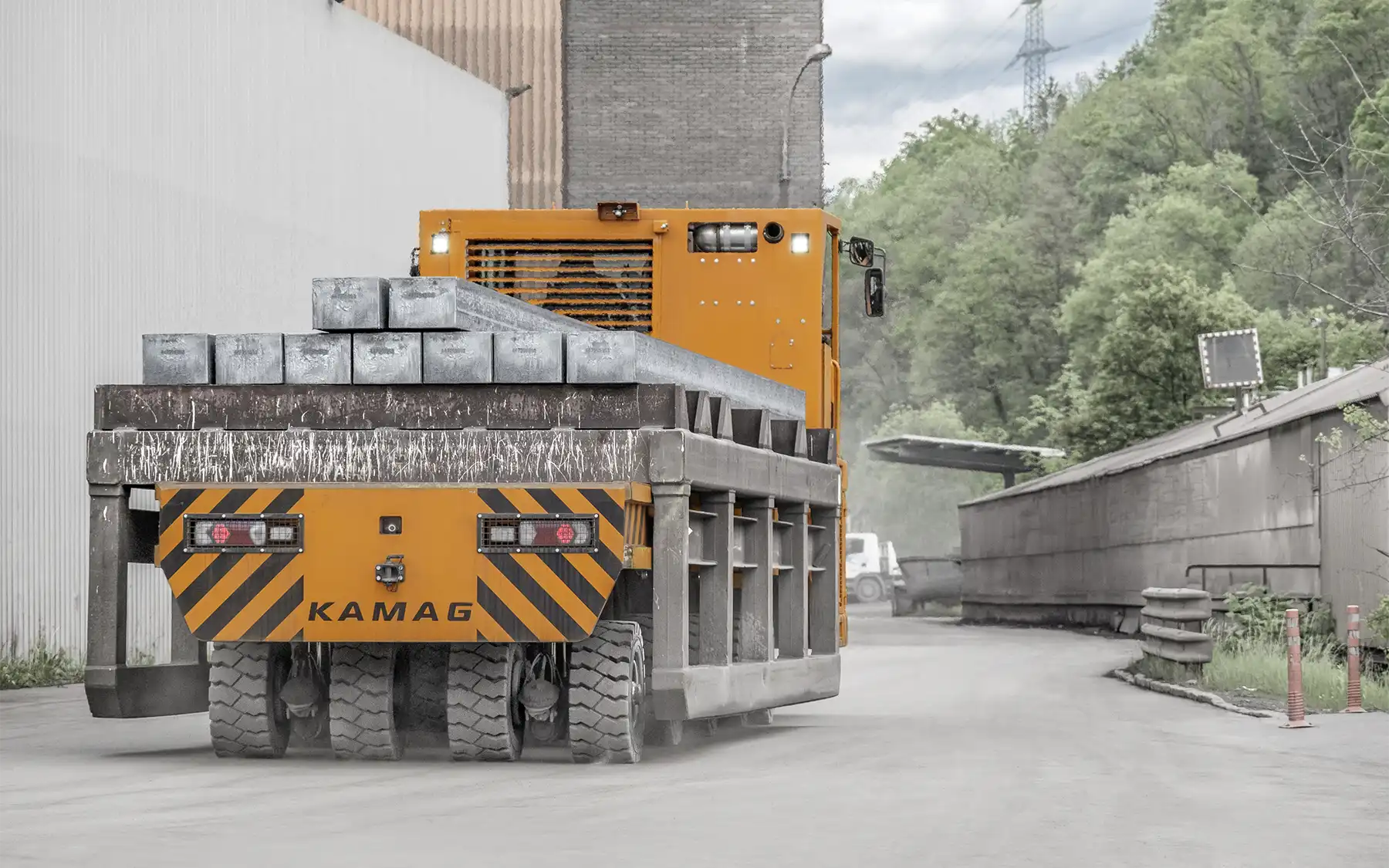
A loaded pallet of steel blooms moves through the mill with no crane involved. That is the whole point of this machine.
Industrial transporter vs. SPMT: not the same machine
A self-propelled modular transporter (SPMT) is a different tool: combinable axle-line modules with a remote operator, built for project cargo like bridge sections and refinery vessels, and usually rented from a rigging contractor for a single move. An industrial heavy transporter is a single-chassis vehicle with a cab, bought by the plant and run daily on fixed routes by your own operators. If the load moves once, rent the SPMT. If the load moves every shift, that is transporter work.
Two boundary notes inside the family: slag pots ride on a purpose-built machine with heat protection, covered in our slag pot carrier guide, and loads lifted on forks at the front of a counterbalanced machine are heavy forklift work. For container machines, see our guides to reach stackers, loaded container handlers, and empty container handlers.
See it in the plant. A current-generation KAMAG IHT runs a full pickup-and-carry cycle. The clips in this guide are KAMAG units from our own service work; the brand comparison stays neutral.
A current-generation KAMAG IHT running a full pickup-and-carry cycle. Source: Bulk Equipment Corp.
CostHow Much Does an Industrial Heavy Transporter Cost?
A new industrial heavy transporter starts at approximately $750,000 for a base machine at the low end of the payload range, and fully configured heavy units run to roughly $3.25 million or more. No manufacturer publishes pricing; every machine is configured to the load and quoted, and a starting price means exactly that: low capacity, base features, before tariffs and shipping. For another verified reference point in the same machine family, new slag pot carriers run $1.5 million to $4 million; see the slag pot carrier guide.
- Payload and deck. The rating and the deck dimensions set the machine class, the axle count, and the baseline price.
- Lift system. Lift height, lift speed, and whether the deck must pick from pallets, stands, or floor-level stillages.
- Heat package. Hot slabs and molten-metal pallets demand shielding and protected hydraulics a cold-coil plant never pays for.
- Steering and maneuvering. Multi-axle electronic steering for tight aisles and long reversing runs adds cost and earns it back in route flexibility.
- Diesel versus electric. Electric drive in this class is real now, at a premium up front and a lower cost per hour where the duty cycle fits.
- Customization depth. A standard payload step from a series costs less and arrives sooner than a fully custom engineering project.
The sticker is only half the math. These machines exist to remove crane dependency, so the real comparison is the transporter’s cost per move against crane wait time, crane maintenance, and the production lost when the crane becomes the bottleneck. A transporter that runs is cheap; one waiting on overseas parts is not.
What will a transporter actually cost you?
Send us your load, deck size, and route. We come back with real numbers for new, used, rebuilt, or an all-in monthly package. No runaround on price.
The ComparisonKAMAG vs. Cometto vs. Kress vs. Paling
Four manufacturers build true in-plant heavy transporters with North American reach.
| Spec | TII KAMAG | Cometto | Kress | Paling |
|---|---|---|---|---|
| Line and models | IHT lift transporter; SlabCarrier; PrecisionMover | ETH and ETL industrial elevating transporters; Eco1000 | Coil carriers, slab carriers, custom transporters | CTS heavy lift transporters |
| Payload range | IHT 40 to 400 t; custom beyond the catalog | 20 to 400 t | Custom-engineered per load | 200+ t |
| Configurations | U-frame and platform decks, underfloor or platform cab | ETH high cab; ETL low-profile for long loads | Custom-engineered per load, articulated steering | Slab, coil, billet, and scrap configurations |
| Power and controls | Caterpillar and MTU power, Siemens controls with remote diagnostics | Diesel; automatic fire suppression offered | Caterpillar power modules | Hydro-dynamic drivetrain |
| Standout | Broadest standardized series line in the class | Low-profile ETL for long products | Custom-engineered per application | North American-built and serving steel mills since 1986 |
TII KAMAG
KAMAG builds the IHT line from 40 to 400 tons, with U-frame and platform decks, underfloor or platform cab positions, Caterpillar and MTU power, and Siemens controls with remote diagnostics. The series tops out at 400 tons, with custom engineering available beyond the catalog.
Cometto
Cometto builds industrial elevating transporters from 20 to 400 tons in two body styles: the ETH with a high-mounted cab, and the low-profile ETL built for long products like bars, pipe, and girders.
Kress
Kress Corporation custom-builds coil carriers and slab carriers, each engineered to the customer’s exact load and site on Caterpillar power modules. Kress machines are one-off engineering rather than a series catalog.
Paling
Paling Transporter has built CTS heavy lift transporters for slabs, coils, billets, and scrap since 1986, at 200-plus tons, with a hydro-dynamic drivetrain.
The adjacent classes, honestly
Sometimes the right answer is not a transporter at all. Heavy forklifts carry to about 85 tons on forks and stack, which transporters do not. SPMTs (Scheuerle, Goldhofer) rent by the move for project cargo. Wheelift, Green Valley, and HUBTEX cover the precision and lighter classes, and Mol CY and Kirow build related machines in Europe, so ask the North American support question hard. We will tell you which class your load actually needs, even when the answer is not a machine we sell.
Ready to spec a KAMAG transporter?
Dig into the IHT line, capacities, and configurations on the Bulk Lift Products equipment site.
See It WorkWhat Does an Industrial Transporter Look Like in Operation?
Here it is on the move: a transporter carries a loaded pallet across a working floor while the overhead crane stays free for the lifts only it can do.
KAMAG IHT carrying a loaded pallet on the move. Source: Bulk Equipment Corp.
SubtypesWhich Type of Industrial Transporter Fits Your Load?
The class splits by what rides on the deck. Match the subtype to the load first; the brand conversation comes second.
U-Frame Lift Transporters
- Drive under and lift palletized loads: scrap pallets, billet stillages, slab pallets
- The workhorse configuration of the class, 40 to 400 tons
- No crane, no rigging, no transfer stand in the cycle
Low-Profile Flat-Deck
- Long products: bars, pipe, girders, beams
- Low deck height for low buildings and long, flexible loads
- Cometto’s ETL is the reference configuration here
Coil Transporters
- V-deck or cradle decks that carry coils without crushing edges
- 20 to 150+ tons, hot and cold coil applications
- Lighter-class options from Green Valley and HUBTEX below the heavy machines
Slab Carriers
- Hot and cold slab transport between caster, yard, and mill
- KAMAG SlabCarrier series and Kress custom slab carriers
- Heat packages sized for slab temperatures
Die & Mold Transporters
- Stamping dies and casting molds, roughly 5 to 50+ tons
- Precision placement at press lines and casting decks
- The light end of the class, where AGV options also appear
Slag Pot Carriers
- The molten-cargo specialist of the family, with heat protection throughout
- U-frame pot pickup, 60 to 250 ton payloads
- Covered in full in our slag pot carrier guide
One more axis is arriving: electric drive. Battery-electric options are appearing across the class, though diesel still dominates installed fleets. If your plant has a decarbonization mandate, ask every builder the electric question when you spec; the answers are changing year to year.
Configuration spotlight. A closer look at how the deck, lift system, and steering come together on a KAMAG IHT.
KAMAG IHT configuration spotlight. Source: Bulk Equipment Corp.
ProblemsWhat Fails on an Industrial Transporter (and What It Costs You)
These machines carry maximum load at low speed all day, which concentrates wear in predictable places. Knowing them before you buy is how you spec the support plan.
- Tires. Hundreds of tons over a handful of axles on abrasive mill floors makes tires the steadiest operating cost on the machine.
- Lift hydraulics. The elevating deck works under full load every cycle; cylinders, hoses, and valves are the wear core of the machine.
- Heat exposure. Hot slabs and molten-metal pallets cook hoses, wiring, and seals; heat shielding is a wear item to inspect, not a fit-and-forget option.
- Electrical and controls. Diagnostic time is downtime. From our own service calls, panel layout makes a measurable difference; here is what we see inside KAMAG electrical panels.
- Steering systems. Multi-axle electronic steering needs alignment and sensor discipline; neglected, it eats tires and stresses the frame.
- Parts lead time. The biggest hidden cost on European-built machines is an ocean between you and a part. Stock the wear items stateside and put a service plan in writing before the machine lands.
None of this rules out a brand; it is the duty cycle. A frame-up rebuild on a structurally sound transporter resets the cost curve for far less than a new build, without the overseas lead time.
Already running a transporter? Keep it running.
Brand-independent field service, certified welding and line boring, and frame-up rebuilds on any make. Tell us what is down.
OwnershipBuy New, Buy Used, Rebuild, or an All-In Monthly Package?
There are four realistic ways to put a transporter on your floor: buy new, buy used, rebuild what you have, or take an all-in monthly package. The right one depends on your utilization, your capital plan, and how much downtime risk you want to own.
| Way to get one | Best when | Trade-off |
|---|---|---|
| Buy new | A long-horizon plant that wants current controls, diagnostics, and a configuration matched exactly to the load | Highest outlay and OEM build lead times |
| Buy used | A budget bridge, a backup unit, or a proven platform for a standard load | Custom-built machines rarely match a new site perfectly; inspect frame and lift system hard |
| Frame-up rebuild | Your transporter’s frame is sound but the powertrain, hydraulics, and wiring are tired | The machine is out of service during the rebuild; plan coverage |
| All-in monthly package (Equipment-as-a-Service) | You want guaranteed availability at one predictable flat monthly cost with zero capital outlay | Longer-term, site-specific commitment |
The all-in monthly package, sometimes called Equipment-as-a-Service, is the one most plants do not know exists. Equipment and service bundle into one flat monthly rate: Bulk owns the machine, runs proactive PM, stocks the wear parts, and guarantees availability, with zero capital outlay. For a machine this central to plant flow, moving that risk off your books can beat the sticker math of owning.
Not sure which way to go? Talk it through.
Tell us your loads and utilization, and we will lay out whether new, used, a rebuild, or the all-in monthly package fits your plant.
The DecisionWhat Makes a Transporter “Best” for Your Plant
There is no single best industrial transporter, only the best match for your load, your routes, and the partner behind the machine. Run any option through four filters.
- Match the load and pallet system. Payload, deck dimensions, and how your loads sit today (pallets, stillages, stands) decide the subtype and the class.
- Match the route. Floor condition, grades, door heights, aisle widths, and turning radii decide deck height, steering spec, and cab position.
- Match the environment. Hot loads need a heat package; outdoor routes need weather spec; tight melt shops favor electronic multi-axle steering.
- Weigh the support. Parts lead time and time to a qualified tech decide your real cost per move. An ocean in the supply line is a spec decision too.
Ask the plants that run these machines and the pattern is consistent: the configuration matters more than the badge, and the support plan matters more than both.
By IndustryWhere Industrial Transporters Earn Their Keep
The class was born in steel, but the machine goes wherever loads outgrow cranes. Here is how the work differs across the operations that run them.
Steel Mills & EAF Shops
- Slab, coil, and billet transport between caster, yard, and rolling mill
- Scrap pallet and charge logistics feeding the EAF
- The heaviest custom units, to 500+ tons, live here
- Heat packages for hot slabs and furnace-area routes
Aluminum & Non-Ferrous
- Ingot, sow, and coil movement at smelters and rolling operations
- Molten-metal pallet transport with full heat protection
- Coil decks sized to soft-alloy edge protection
Heavy Fabrication & Energy
- Press dies, molds, gearboxes, and machined components between bays
- Wind, turbine, and vessel components staged without crane queues
- Shipyard block and section moves at the heavy end
Mill & Slag Services
- Contractor fleets moving slag, scale, and by-products on customer sites
- Pot carriers and transporters working the same routes under one service plan
- Used and rebuilt units matched to contract terms
In the field. Another look at the transporter working a heavy-industry route under load.
KAMAG IHT working under load. Source: Bulk Equipment Corp.
ProofFrom Our Own Service Work
What we see with the panels open
We service KAMAG machines in the field, so our view of this class comes from service calls, not brochures. Before you buy any brand, read how an electrical panel laid out for troubleshooting changes diagnostic time and the length of a service call when production is waiting. That detail never appears on a spec sheet and always appears on your downtime report.
Read the write-up: inside the KAMAG electrical panel layout.
AnswersFrequently Asked Questions
How much does an industrial heavy transporter cost?
A new industrial heavy transporter starts at approximately $750,000 for a base machine at the low end of the capacity range, and fully configured heavy units run to roughly $3.25 million or more, before tariffs and shipping. Capacity, deck, lift system, heat package, and steering drive the number. A frame-up rebuild of a structurally sound unit costs a fraction of new replacement, so ask for both numbers when you get a quote.
What else is this machine called?
The same machine class appears as industrial transporter, lift transporter, industrial elevating transporter, elevating platform transporter, and self-propelled platform transporter. Used-equipment listings often file them under self-propelled elevating platform trailers. KAMAG’s model line is literally named IHT, for Industrial Heavy Transporter.
What is the difference between an industrial transporter and an SPMT?
An SPMT is a set of combinable axle-line modules, remote-operated, built for one-time project cargo moves and usually rented from a rigging contractor. An industrial heavy transporter is a single-chassis vehicle with an operator cab, bought by the plant and run daily on fixed routes. Loads that move once are SPMT work; loads that move every shift are transporter work.
Who makes industrial heavy transporters?
The manufacturers with North American reach are TII KAMAG (IHT line, 40 to 400 tons), Cometto (ETH and ETL, 20 to 400 tons), Kress (custom coil and slab carriers built in Illinois), and Paling Transporter (built in Ontario). Wheelift, Green Valley, and HUBTEX cover the precision and lighter classes.
Can a transporter replace an overhead crane?
For horizontal moves, largely yes: the transporter picks up palletized loads anywhere and sets them down anywhere, which removes the crane from the transport loop and frees it for lifting work only a crane can do. Plants do not usually remove cranes; they stop expanding crane coverage and stop letting crane queues pace production.
How much weight can an industrial transporter carry?
Series machines run from about 20 tons up to 400 tons, around 880,000 pounds, and manufacturers take on custom engineering beyond the catalog for specific loads.
Are electric industrial transporters available?
Yes, electric drive has entered the class and options are spreading, though diesel still dominates installed fleets. Whether electric fits comes down to your duty cycle and charging window, so ask every manufacturer the electric question when you spec a machine.
What is the difference between an industrial transporter and a heavy forklift?
A heavy forklift carries loads on forks ahead of the front axle, counterbalanced by the machine, and can stack; it tops out around 85 tons. A transporter carries the load on or within its own chassis on an elevating deck, which is why the class reaches 400-plus tons. Forks and stacking favor the forklift; pure heavy horizontal transport favors the transporter.
Talk to UsTell Us Your Load. We Spec the Right Transporter.
We sell, service, and rebuild industrial transporters and the rest of the mill mobile fleet, so the machine we recommend is based on your load, route, and duty cycle, not our inventory. Send your application below and a member of our team follows up with real options for new, used, rebuilt, or an all-in monthly package.