
Heavy Equipment Buyer’s Guide
Loaded Container Handlers: How to Compare, Cost, and Choose
The honest guide to loaded container handlers. Real cost ranges, a straight Konecranes vs Kalmar vs Hyster vs Sany vs Taylor comparison, and the four ways to work with us.
Loaded boxes, 5 to 6 high
First-row stacking muscle
Every major brand
Serviced, rebuilt, and supported
Brand-independent
Honest comparison, no OEM bias
Updated July 2026
A loaded container handler is the workhorse of a busy container yard, and when it goes down, loaded boxes stop moving. This guide gives you the straight answers before you spend: what they cost, how Konecranes, Kalmar, Hyster, Sany, and Taylor compare, what wears and when, and the four ways to put one in your yard. We service and rebuild every brand here, so we have no reason to tell you anything but the truth about all of them.
Bulk Equipment Corp. is a brand-independent heavy-equipment uptime partner with shops in Michigan City, Indiana and Memphis, Tennessee, serving steel mills, scrap yards, ports, and intermodal terminals across the United States. We service and manage fleets for every major heavy equipment brand.
The CategoryWhat Is a Loaded Container Handler?
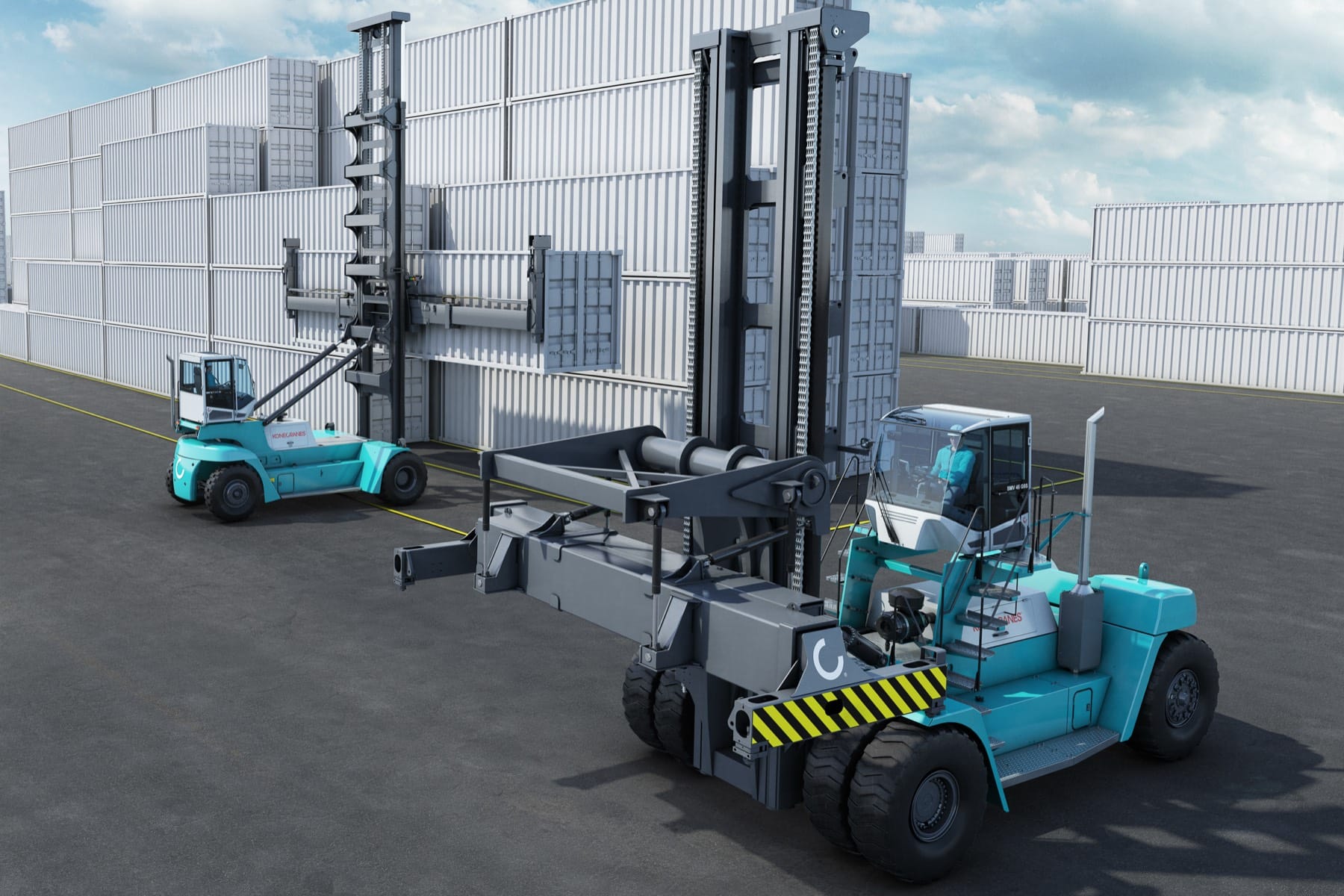
A loaded container handler, also called a laden container handler or top loader, is a mast-type machine with a top-lift spreader built to move and stack loaded shipping containers. Most lift in the 41 to 46 ton class and stack loaded boxes five to six high in the first row. Because the spreader hangs from a mast rather than a telescopic boom, a loaded handler works the first row only, and that is exactly why it stacks higher, cycles faster, and costs less to run than a reach stacker doing first-row work.
| Variant | Typical capacity | Typical work |
|---|---|---|
| Standard loaded handler | 41 to 46 tons | Loaded 20 and 40 ft containers, stacking 5 to 6 high |
| Compact loaded handler | 26 to 37 tons | Lighter boxes and lower stacks |
| Empty-container handler | 8 to 11 tons | Empty boxes only, stacking to 8 high; a separate machine class |
Loaded handlers stack loaded boxes five to six high and cycle faster than any boom machine on first-row work.
One boundary worth drawing: a loaded container handler works the first row only. If you need to reach the second or third row, or work over a rail car, you want a reach stacker. If the boxes are empty, an empty container handler does the job for far less money. And if your loads ride on forks rather than a spreader, start with our heavy-capacity forklift guide.
CostHow Much Does a Loaded Container Handler Cost?
A new loaded container handler starts at approximately $500,000. Beyond that, no honest number exists without a conversation, because the machine gets configured around your box weights, your stacking height, and your spreader spec, and heavy-spec, high-mast machines run well past the starting point.
- Capacity and mast height. Stacking six high on heavy boxes costs more than five high on average ones.
- Spreader spec. Side shift, tilt, and overweight-rated spreaders move the number.
- Duty cycle. A three-shift terminal machine needs a heavier spec than a few-lifts-a-day yard machine.
- Tires. A major recurring cost in high-cycle container work, not a one-time line item.
Sticker price is the wrong number to fixate on. Cost per hour over the machine’s life is what matters, and that is driven by uptime, parts availability, and how fast a tech reaches you when it goes down. A cheap machine that sits broken is the most expensive one you can buy.
What will a loaded container handler actually cost you?
Send us your box weights and stack heights. We come back with real numbers to rent, buy, or run it as one monthly uptime package. No runaround on price.
The ComparisonKonecranes vs. Kalmar vs. Hyster vs. Sany vs. Taylor
No single brand wins every yard. Spec for spec:
| Spec | Konecranes | Kalmar | Hyster | Sany | Taylor |
|---|---|---|---|---|---|
| Capacity | 26 to 45 t (SMV GC series) | 41 t (DCG410GS) | Up to 88,000 lb (H1050-1150XD-CH) | 41 t (SDCY series) | 88,000 to 90,000 lb (GTX, XLC) |
| Stacking | 3 to 6 high | 4 to 6 high | 5 to 6 high | 5 high | 3 to 6 high |
| Engine | Volvo Penta or Cummins | Volvo D11 | Cummins X12 | Cummins QSL9 | Volvo D13 (XLC series) |
| Transmission | Dana TE-30 | Dana LTE-30500 with lockup | Dana TE-30 | Dana HR series | Dana TE-30 |
| Drive axle | Kessler | Kessler D102 | Kessler D102 | Kessler D102 | Kessler D-102W |
| Tires | 18.00×25 / 18.00×33 | 18.00×33 | 18.00×25 / 18.00×33 | 18.00×33 | 18.00×25 / 18.00×33 |
Look down any column and the pattern is hard to miss: every brand in the class builds around a Kessler D102 drive axle, a Dana heavy powershift transmission, and a Cummins or Volvo engine. Under the paint, these machines share far more than the brochures suggest. What separates them is capacity and mast configuration, spreader spec, telematics, and above all who can support the machine at your site.
The right brand comes down to your box weights, your stack heights, your duty, and most of all who can keep the machine running near you. A great machine with no local support is a liability.
Ready to spec a Konecranes container handler?
Configure capacity, mast, and spreader with the Bulk Lift Products equipment team.
TelematicsWhich Telematics System Comes With Your Container Handler?
Every major brand now offers fleet telematics, and it is worth comparing before you buy because the machine will report to that system for the next 20,000 hours. Konecranes TRUCONNECT has come standard on every new lift truck since 2022; the others vary in what is included, what is paid, and what they publish. One detail that matters in this class: Hyster’s own literature notes its load sensing is not available on high-capacity trucks.
| Capability | Konecranes TRUCONNECT | Kalmar Insight | Hyster Tracker | Taylor TaylorTrak Pro | Sany |
|---|---|---|---|---|---|
| Standard from the factory | Yes, Basic tier since 2022 | Subscription-based | Yes on big trucks, data plan included | Hardware standard on current models | Not published |
| Hours, location, and usage data | Yes | Yes | Yes | Yes | Yes |
| Fault alerts and diagnostics | Yes | Yes, critical alarms | Yes, can trigger service calls | Engine warnings | Stated |
| Fuel and idle reporting | Yes, plus consumption predictor | Yes, plus CO2 | Yes | Yes, plus DEF level | Stated |
| Tire pressure monitoring | Yes, Premium tier | Not published | Not published | Yes | Not published |
| Impact and shock detection | Yes, Premium tier, with map location | Yes | Yes, plus impact lockout and camera | Not published | Not published |
| Operator checklists and access | Daily inspection reports | Yes, driver ID and Inspector app | Yes, paid tiers | Not published | Not published |
| Load and lift data | Container weighing data | Moves and lift types | Load sensing, not on high-capacity trucks | Container lift counts | Not published |
| Hydraulic oil life monitoring | Yes, Premium+ tier | Not published | Not published | Not published | Not published |
“Not published” means the manufacturer does not document the capability publicly, not necessarily that it does not exist; Sany announced its telematics platform in early 2026 and has not yet published availability for port equipment. TRUCONNECT runs three tiers: Basic is free and standard, Premium adds tire pressure and shock monitoring, and Premium+ adds hydraulic oil condition monitoring that can stretch oil life as much as four times.
Component LifeWhat You’ll Replace and When: Loaded Handler Component Life
Everything on a loaded container handler wears on a schedule, and the smart move is planning for it instead of getting surprised by it. Day to day, the regularly replaced items are spreader wear pads, twistlocks (engineered for about 80,000 lock cycles), tires, oils and filters, and hydraulic seal kits. Beyond those, Konecranes publishes factory expected-life figures for its loaded container handlers’ major components, the point where a component is worn beyond economical repair and gets replaced as a unit. Almost nobody shares this data with buyers. Here it is.
| Component | Hard conditions | Normal conditions | Good conditions |
|---|---|---|---|
| Mast | 20,000 hrs | 30,000 hrs | 40,000 hrs |
| Mast bearings | 10,000 hrs | 20,000 hrs | 30,000 hrs |
| Spreader twistlocks | About 5,000 hrs / 80,000 lock cycles regardless of conditions | ||
| Spreader wear pads | 5,000 hrs | 10,000 hrs | 15,000 hrs |
| Engine | 10,000 hrs | 20,000 hrs | 30,000 hrs |
| Turbocharger | 3,000 hrs | 10,000 hrs | 20,000 hrs |
| Transmission | 10,000 hrs | 20,000 hrs | 30,000 hrs |
| Hydraulic pumps | 10,000 hrs | 15,000 hrs | 20,000 hrs |
| Hydraulic cylinders | 15,000 hrs | 20,000 hrs | 30,000 hrs |
| Drive axle | 15,000 hrs | 20,000 hrs | 30,000 hrs |
| Steer axle | 10,000 hrs | 20,000 hrs | 30,000 hrs |
| Chassis | 15,000 hrs | 20,000 hrs | 30,000 hrs |
| Cab interior | 5,000 hrs | 15,000 hrs | 30,000 hrs |
| Tires | 500 hrs | 2,500 hrs | 5,000 hrs |
| Electrical system and ECUs | 10,000 hrs | 15,000 hrs | 30,000 hrs |
Read the columns, not just the rows. The mast is the longest-lived structure Konecranes rates on any of its lift trucks, up to 40,000 hours in good conditions, while the same engine that lasts 30,000 hours in a well-maintained operation is done at 10,000 in a hard one. Operating conditions and maintenance discipline, not the badge on the machine, decide what a loaded handler costs you per hour.
Source: Konecranes factory expected-life data for its loaded container handlers. Other manufacturers do not publish equivalent data. Figures assume components are replaced as complete units, with minor repairs like reseals not counted.
Already running container handlers? Keep them running.
Brand-independent field service and frame-up rebuilds on any make, dispatched from regional hotlines. Tell us what is down.
OwnershipFour Ways to Work With Us, Built for What You Need
There is more than one way to put a loaded container handler to work, and the right one depends on your utilization, your budget, and how much downtime risk you want to own. These are the four.
Equipment as a Service
Full operational outcomes, not just equipment access. Bulk owns the fleet, carries the maintenance risk, and keeps you running.
- Predictable monthly cost. Zero CAPEX
- Bulk-owned fleet with dedicated backup units
- On-site technicians plus proactive PM
- Uptime-focused, not rental-day focused
- Long-term, site-specific structure
- Risk shifts from your operation to Bulk
Equipment Rental
Flexible fleet access when you need it, without the commitment of ownership.
- Flexible rental periods available
- Wide selection of heavy equipment
- Rapid deployment to your site
- Ideal for seasonal demand or project gaps
- No long-term obligation
Equipment Sales
Buy outright from an authorized distributor for the brands you already run, including Konecranes, Sennebogen, and KAMAG.
- New and used inventory available
- Konecranes, Sennebogen, KAMAG and more
- Spec’d to your application
- Financing and trade-in options
- Factory-backed support
Field Service
Brand-independent heavy equipment maintenance and repair. Call a regional hotline and we will have a technician on site fast.
- Brand-independent: any machine, any OEM
- Regional hotlines for rapid dispatch
- Parts sourcing and full complement inventory
- No need to keep a specialist on payroll
- Established in the steel mill environment
Not sure which way fits? Talk it through.
Tell us your utilization and budget, and we will lay out whether buying, renting, or the all-in monthly package fits your yard.
The DecisionWhat Makes a Loaded Handler “Best” for Your Yard
There is no single best loaded container handler, only the best match for your boxes, your yard, and the partner behind it. Answer these four questions and the right machine specs itself.
- What is the heaviest box you are trying to lift? Buy on your real box weights, including the overweight ones, not the yard average.
- How high do you need to stack? Five high and six high are different masts and different machines, and going taller later is not an option.
- How many lifts a shift, and how many shifts a day? A three-shift terminal machine needs a heavier spec and PM program than one covering a few lifts a day.
- Who is going to keep it running near you? Response time, parts availability, and whether anyone near you can service that brand decide your real cost per hour.
By IndustryLoaded Container Handler Applications: Industries We Serve
Ports & Terminals
- Loaded container stacking five to six high in dense yard blocks
- Fast first-row cycling for high-throughput vessel and gate operations
- Overweight-box handling with high-capacity models
Rail & Intermodal
- Loaded box transfer between truck, stack, and gate
- Pairs with reach stackers that work the rail while the loaded handler runs the stacks
- High-cycle duty at rail-served distribution hubs
Logistics & Distribution
- Container-based receiving and shipping at large DCs
- Densifying yard storage by stacking loaded boxes instead of wheeling them
- One machine covering dock, stack, and gate moves
Scrap & Export Loading
- Stacking and staging loaded export boxes of processed scrap
- Heavy, dense cargo that pushes box weights toward machine limits
- Dusty, high-abuse duty cycles
AnswersFrequently Asked Questions
How much does a loaded container handler cost?
A new loaded container handler starts at approximately $500,000. The final number depends on your box weights, your stacking height, and your spreader spec, and heavy-spec, high-mast machines run well past the starting point, so treat any figure as the start of a conversation rather than a quote.
How do Konecranes, Kalmar, Hyster, Sany, and Taylor loaded handlers compare?
Under the paint they are remarkably alike: every brand in the class builds around a Kessler D102 drive axle, a Dana heavy powershift transmission, and a Cummins or Volvo engine. The real differences are capacity and mast configuration, spreader spec, telematics depth, and local support.
What is the difference between a loaded container handler and a reach stacker?
A loaded container handler lifts with a spreader on a mast and works the first row only, which lets it stack higher and cycle faster for less money. A reach stacker lifts with a telescopic boom and can work the second and third rows or over a rail car. If your yard never needs second-row reach, the loaded handler is usually the better buy; if it does, you need the reach stacker.
How high can a loaded container handler stack?
Most loaded handlers stack loaded containers five to six high in the first row, depending on the model, mast, and box weights. That is typically one to two boxes higher than a reach stacker manages on loaded first-row work, which is the loaded handler’s core advantage in a dense yard.
How long does a loaded container handler last?
Konecranes factory data rates the mast at up to 40,000 hours in good conditions, the longest-lived structure on any of its lift trucks, with major components like the engine, transmission, and drive axle at 20,000 to 30,000 hours in normal to good conditions and as little as 10,000 to 15,000 in hard ones. Maintenance discipline, not the badge, is the biggest variable.
Can a loaded container handler lift empty containers too?
Yes, a loaded machine handles empties without breaking a sweat, but it is expensive overkill for an all-empties operation. A dedicated empty container handler costs far less to buy and run and stacks empties higher. The reverse is never true: an empty handler must not lift loaded boxes.
Can one company service all of these brands?
Yes. Brand-independent service providers maintain, repair, and rebuild container handlers of any make, whether or not they sold you the machine. For a mixed fleet, one accountable partner that covers every brand in the yard is often more valuable than tying yourself to a single OEM dealer.
Should I rent or buy a loaded container handler?
Buy when utilization is high and the horizon is long, because cost per hour drops with ownership over time. Rent for seasonal peaks, projects, or backup coverage. If you want a machine in the yard with guaranteed uptime and no capital outlay, Equipment as a Service sits between the two: one flat monthly cost, Bulk owns the fleet and carries the maintenance risk.
Talk to UsTell Us Your Yard. We Spec the Right Container Handler.
We sell, rent, and service container handlers of every major brand, so the machine we recommend is based on your boxes and duty cycle, not our inventory. Send your application below and a member of our team follows up with real options to rent, buy, or run it as a monthly uptime package.