
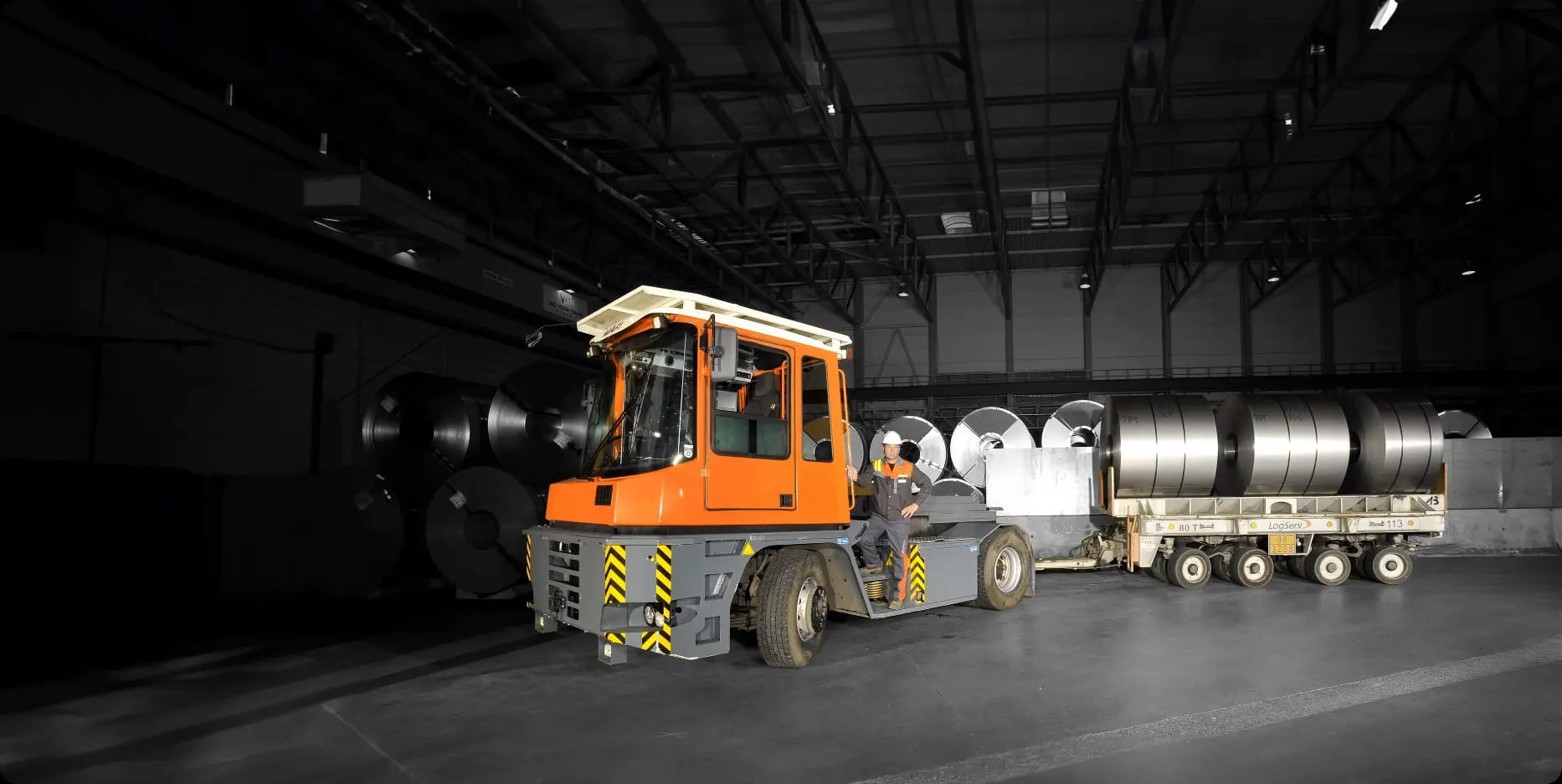
Heavy Equipment Buyer’s Guide
Terminal Tractors & RoRo Tractors: How to Compare, Cost, and Choose
The honest guide to yard spotters and heavy RoRo tractors. The standard-vs-heavy split nobody explains, what a “MAFI trailer” actually is, and who builds the heavy class in North America.
25 to 45 tons
Fifth-wheel lift, standard to heavy
Up to 250 t GCW
Heavy RoRo combination weights
Brand-independent
Honest comparison, no OEM bias
Updated August 2026
A terminal tractor shuttles trailers all day so road trucks and cranes never wait. The catch when you go shopping: the name covers two very different machines, the 81,000-pound yard spotter that runs distribution yards and the 150-plus-ton four-wheel-drive RoRo tractor that climbs vessel ramps and hauls steel. This guide explains the split, how the brands compare, and what a “MAFI trailer” actually is. We work on this class regardless of brand, so we have no reason to tell you anything but the truth about all of them.
Bulk Equipment Corp. is a brand-independent heavy-equipment uptime partner with shops in Michigan City, Indiana and Memphis, Tennessee, serving steel mills, scrap yards, ports, and intermodal terminals across the United States. We service and manage fleets for every major heavy equipment brand.
The CategoryWhat Is a Terminal Tractor?
A terminal tractor is a purpose-built truck that moves trailers short distances inside a facility: a single-seat cab with a rear door to the catwalk, a hydraulically lifting fifth wheel so the driver never cranks landing gear, and a turning radius a road tractor cannot touch. Depending on the region and the yard, the same machine is called a yard truck, yard spotter, spotter truck, hostler, yard jockey, yard dog, shunt truck (in Canada), or terminal truck. One driver, one machine, dozens of trailer moves a shift: that is the job.
Boundary notes: if the load rides on the machine itself instead of a trailer, you are in industrial heavy transporter territory, and container stacking belongs to reach stackers, loaded and empty container handlers. For coils and slabs on forks, see heavy-capacity forklifts, and for molten slag, slag pot carriers.
The SplitYard Spotter vs. Heavy RoRo Tractor: Which Class Do You Need?
This is the decision almost nobody explains. A standard 4×2 spotter is built around an 81,000-pound GCWR and a 25-ton-class lifting fifth wheel for distribution and intermodal yards. A heavy RoRo tractor is 4×4, lifts 32 to 45 tons at the fifth wheel, runs combination weights to 250 tonnes, and adds the gooseneck and rotating seat that ramp and steel work demand. Send a spotter up a vessel ramp and you will destroy it; park a heavy RoRo tractor in a distribution yard and you paid double for nothing.
| Standard yard spotter | Heavy RoRo / industrial tractor | |
|---|---|---|
| Drive | 4×2 | 4×4 for ramps and traction |
| GCW class | ~81,000 lb GCWR | 150 to 250 t (330,000 to 551,000 lb) |
| Fifth-wheel lift | ~25 ton class | 32 to 45 tons |
| Trailer interface | Standard fifth wheel | Fifth wheel plus gooseneck for roll trailers |
| Operator station | Fixed seat, rear catwalk door | Rotating seat for loaded driving in both directions |
| Where it works | Distribution centers, intermodal lots, warehouse yards | RoRo vessel decks and ramps, steel mills, foundries, heavy industrial haulage |
| Who builds it | Kalmar Ottawa, TICO, Capacity, Autocar, Orange EV, BYD | MAFI, Terberg RT series, Kalmar TR618i |
Port-spec heavies like the Capacity TJ 9000 (242,000 pounds GCWR) sit between the two, still 4×2 with no RoRo gooseneck. If your work includes vessel ramps, roll trailers, or steel-mill trailer trains, you are in the heavy class, and in North America that class comes down to a short list of builders.
The ComparisonWho Builds Terminal and RoRo Tractors?
The standard segment is crowded and competitive; the heavy RoRo segment in North America comes down to three brands. Here is the field, honestly.
| Brand | Key models | Class | Segment |
|---|---|---|---|
| MAFI | R 332, R 336, HD 445, Z ballasted variants; T series spotters | R 336: 36 t fifth wheel, 4×4, 176 t system load; HD 445: 45 t lift, 250 t system load | Heavy RoRo / industrial |
| Terberg | YT series; RT223 to RT403 (4×4) | RT: 150 to 190 t GCW, to 45 t fifth wheel | Both |
| Kalmar Ottawa | T2, T2E electric; TR618i (4×4) | T2: 81,000 lb GCWR; TR618i: 32 t fifth wheel | Both |
| TICO | Pro-Spotter, Pro-Spotter Electric | To 160,000 lb GCW electric | Standard / port |
| Capacity | Sabre 5, TJ series to TJ 9000 | TJ 9000: 242,000 lb GCWR | Standard / heavy port |
| Autocar | ACTT XSpotter | 81,000 lb GCWR | Standard |
| Orange EV | e-TRIEVER, HUSK-e | 81,000 lb GCWR, electric only | Standard |
MAFI
MAFI Transport-Systeme is the steel mill and RoRo specialist of the field. The R 332 and R 336 are 4×4 RoRo tractors with fifth-wheel lifts to 36 tons and system loads to 176 tons; the HD 445 lifts 45 tons with system loads to 250 tons; the Z variants add ballasted drawbar configurations that pull even greater loads in heavy trailer trains. If the duty is vessel ramps, foundry trailers, or coil haulage, this is the machine class MAFI built its name on.
Terberg
Terberg is MAFI’s most direct rival. The YT series covers standard spotting; the 4×4 RT series runs from the RT223 at 150 tonnes GCW to the RT403 at 190 tonnes with a 45-ton fifth wheel, built for steelworks and RoRo decks.
Kalmar Ottawa
Kalmar Ottawa builds the T2 yard spotter in Ottawa, Kansas, plus the T2E electric, backed by a deep dealer and parts network across North America. At the heavy end, the TR618i is its 4×4 RoRo tractor with a 32-ton fifth-wheel lift.
The standard-segment field
TICO builds port-grade spotters, including an electric Pro-Spotter to 160,000 pounds GCW. Capacity runs from the Sabre 5 to the TJ 9000 at 242,000 pounds GCWR. Autocar’s ACTT comes with a big on-road dealer network behind it. Orange EV builds electric yard trucks exclusively. All are credible machines for yard work; none of them climbs a vessel ramp under 150 tonnes, and that is the line that matters.
The right machine comes down to the duty class first, then the spec sheet, then who can keep it running near you.
Ready to spec a MAFI tractor?
Dig into the HD 445, R 336, R 332, and the ballasted Z variants, with US spec sheets, on the Bulk Lift Products equipment site.
The NameWhat Is a MAFI Trailer? (And Why the Name Causes Confusion)
In ports worldwide, “a mafi” or “MAFI trailer” means a roll trailer: a low steel platform on solid wheels, typically 20, 40, or 62 feet long and rated from 40 to over 100 tonnes, used to roll cargo on and off RoRo vessels. The name is genericized from MAFI Transport-Systeme, the German company that popularized the trailers and still builds them, along with the tractors that pull them. So MAFI is a brand; “a mafi” is the trailer; and the machine this page covers is the tractor that works both.
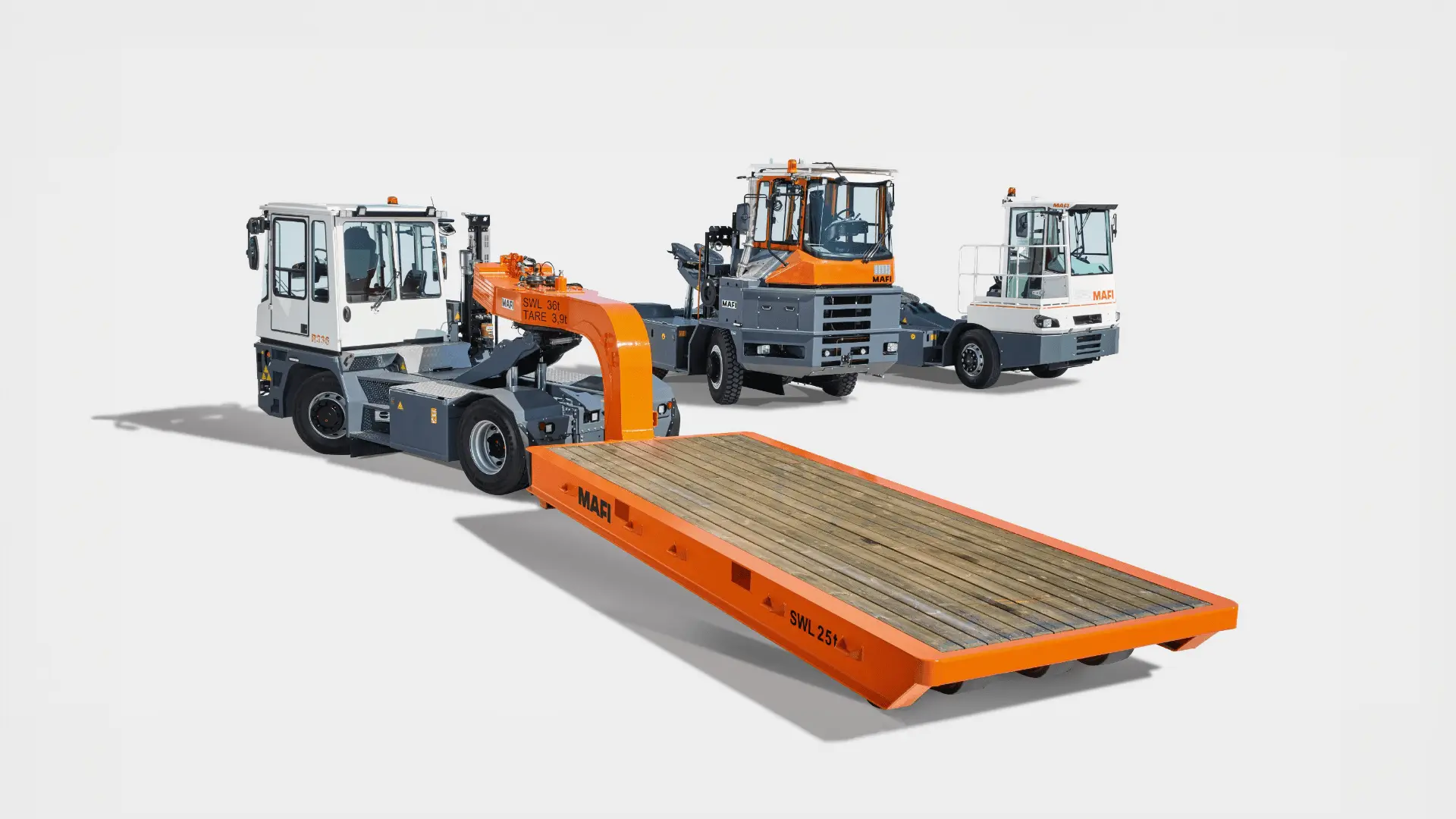
An R 336 with its gooseneck set in a roll trailer’s front pocket, alongside two terminal tractors. The gooseneck lifts the trailer nose; the tractor does the rest.
The gooseneck is the key piece of hardware: a lifting arm that drops into the pocket at the front of the roll trailer, raises the nose, and turns trailer and cargo into one rolling unit. Watch the cycle once and the whole RoRo system makes sense.
ProblemsWhat Fails on a Terminal Tractor (and What It Costs You)
Terminal tractors live a life of constant coupling, tight turns under load, and stop-and-go cycles that road trucks never see. The wear concentrates in predictable places.
- Fifth-wheel lift hydraulics. The lifting fifth wheel cycles under full trailer weight dozens of times a shift; hoses, cylinders, and valves are the number-one wear system.
- Transmissions. Constant loaded starts and direction changes punish transmissions and torque converters, especially on undersized machines doing heavy work.
- Tires and suspension. Full-lock turns under load scrub tires and load suspensions in ways highway miles never do.
- Electrical and sensors. Lights, sensors, and harnesses take a beating from vibration and weather; diagnostic time is downtime.
- Ramp duty on the heavy class. Wet steel vessel ramps test driveline, brakes, and traction systems; this is exactly what the 4×4 RoRo machines are engineered for, and what kills machines that are not.
- Undersizing. The most expensive failure mode is buying a standard spotter for heavy duty. The machine fails early and takes uptime with it.
None of this rules out a brand; it is the duty cycle. Disciplined PM on the lift system and honest sizing on day one prevent most of it, and a brand-independent service partner covers the mixed fleet most yards actually run.
Already running yard tractors? Keep them running.
Brand-independent field service and rebuilds on any make, dispatched from regional hotlines. Tell us what is down.
OwnershipBuy New, Buy Used, Rent, or an All-In Monthly Package?
Terminal tractors have the liveliest rental and used market of any machine on this site, which makes the acquisition question genuinely open. The right answer depends on utilization, duty class, and how much downtime risk you want to own.
| Way to get one | Best when | Trade-off |
|---|---|---|
| Buy new | High moves per shift, long horizon, or heavy/RoRo duty where the spec must be exact | Highest outlay; heavy class adds OEM lead times |
| Buy used | Standard yard duty on a budget; the used spotter market is deep and liquid | Hour meters lie less than paint; inspect the lift system and transmission |
| Rent | Seasonal peaks, projects, or covering a down machine | Higher long-run cost; heavy RoRo rentals are scarce |
| All-in monthly package (Equipment-as-a-Service) | You want guaranteed uptime at one predictable flat monthly cost with zero capital outlay | Longer-term, site-specific commitment |
The all-in monthly package, sometimes called Equipment-as-a-Service, bundles the tractor and its service into one flat monthly rate: Bulk owns the machine, runs proactive PM, and guarantees uptime, with zero capital outlay. For a yard where every trailer move feeds a dock schedule, moving that risk off your books can beat the sticker math of owning.
Not sure which way to go? Talk it through.
Tell us your moves per shift and duty class, and we will lay out whether new, used, rental, or the all-in monthly package fits your yard.
The DecisionWhat Makes a Terminal Tractor “Best” for Your Yard
There is no single best terminal tractor, only the best match for your duty, your trailers, and the partner behind the machine. Run any option through four filters.
- Match the duty class honestly. Ramps, roll trailers, or steel-mill trailer weights mean the heavy 4×4 class. Everything else means a standard spotter, and the savings are real.
- Match the spec. Fifth-wheel lift capacity, GCW, gooseneck capability, fifth-wheel height range, and DOT spec if the tractor crosses public roads.
- Match the energy. Diesel for flexibility and the heavy class; electric where duty cycles, charging, and emissions goals line up.
- Weigh the support. Parts availability and time to a qualified tech decide your real cost per move, and they vary more between brands than any spec does.
Ask the people who run these yards and the answer is consistent: the badge matters less than the lift cycle count the machine survives. The best tractor is the one moving trailers when the dock needs them moved.
By IndustryWhere Terminal and RoRo Tractors Earn Their Keep
The same machine family works very different jobs depending on the yard. Here is how the duty changes across the operations that run them.
Ports & RoRo Terminals
- Roll-trailer and cargo moves on and off vessel decks via stern ramps
- 4×4 heavy tractors with goosenecks and rotating seats
- Wet steel ramps where traction and braking are the spec drivers
Steel Mills & Heavy Industry
- Coil, slab, and billet trailers between bays and yards
- Ballasted drawbar tractors for heavy trailer trains
- The duty that separates the heavy class from yard spotters
Intermodal & Rail
- Trailer and chassis shuttling at ramps and container yards
- High moves-per-shift duty where cycle speed is the metric
- DOT-spec units for crossing public roads between lots
Distribution & Manufacturing
- Dock shuttling that keeps doors fed and road drivers rolling
- The standard 4×2 spotter’s home turf
- Where electric yard tractors are being adopted fastest
AnswersFrequently Asked Questions
Is a terminal tractor the same as a yard spotter or hostler?
Yes. Terminal tractor is the industry term; yard truck, yard spotter, spotter truck, hostler, yard jockey, yard dog, and shunt truck (in Canada) all describe the same machine. Note that “hostler” and “yard jockey” sometimes refer to the driver rather than the truck.
What is a MAFI trailer, and is MAFI a brand?
Both. MAFI Transport-Systeme is a German manufacturer of terminal and RoRo tractors and roll trailers. Because its roll trailers became the port standard, “a mafi” became the generic term for any roll trailer: the low steel platform, rated 40 to over 100 tonnes, that rolls cargo on and off RoRo vessels behind a tractor with a gooseneck.
How much does a terminal tractor cost?
Manufacturers in this class do not publish transaction prices; spotters are quoted to spec, and the heavy 4×4 RoRo class is quote-only everywhere. Tell us your moves per shift, trailer weights, and duty class and we will come back with real numbers for new, used, rental, or an all-in monthly package.
What is the difference between a yard spotter and a RoRo tractor?
A yard spotter is a 4×2 tractor built around an 81,000-pound GCWR and a 25-ton-class lifting fifth wheel, made for distribution and intermodal yards. A RoRo tractor is 4×4, lifts 32 to 45 tons at the fifth wheel, handles combination weights to 250 tonnes, adds a gooseneck for roll trailers and a rotating seat, and is built to climb vessel ramps and work steel mills. They are not interchangeable in either direction.
When do I need a 4×4 terminal tractor?
When the work includes vessel ramps, steep or slick grades, or trailer weights beyond the standard spotter class. Four-wheel drive is about traction under load where a spinning wheel means a stalled ship or a blocked mill road, not about off-road capability.
Are electric terminal tractors worth it?
In the standard segment, often yes: electric spotters cost more up front, and manufacturers claim significant fuel and maintenance savings where the duty cycle and charging window fit, so make them show the math on your shift pattern. In the heavy RoRo segment, electric is only beginning to appear, and diesel remains the standard.
What does DOT versus off-road spec mean?
An off-road terminal tractor never leaves private property, so it skips road-legal equipment. A DOT-spec unit adds the lighting, braking, and registration needed to cross or drive on public roads between facilities. If your yards sit across a public street from each other, spec DOT on day one; it is expensive to retrofit.
Who makes heavy RoRo tractors in North America?
The principal heavy 4×4 RoRo and industrial builders with North American support are MAFI (R and HD series, US subsidiary in Georgia), Terberg (RT series, built in Columbus, Mississippi), and Kalmar (TR618i). For anything else, ask the North American support question hard before you commit.
Talk to UsTell Us Your Yard. We Spec the Right Tractor.
We sell, service, and rebuild terminal tractors and the rest of the heavy mobile fleet, so the machine we recommend is based on your moves, trailers, and duty class, not our inventory. Send your application below and a member of our team follows up with real options for new, used, or an all-in monthly package.