
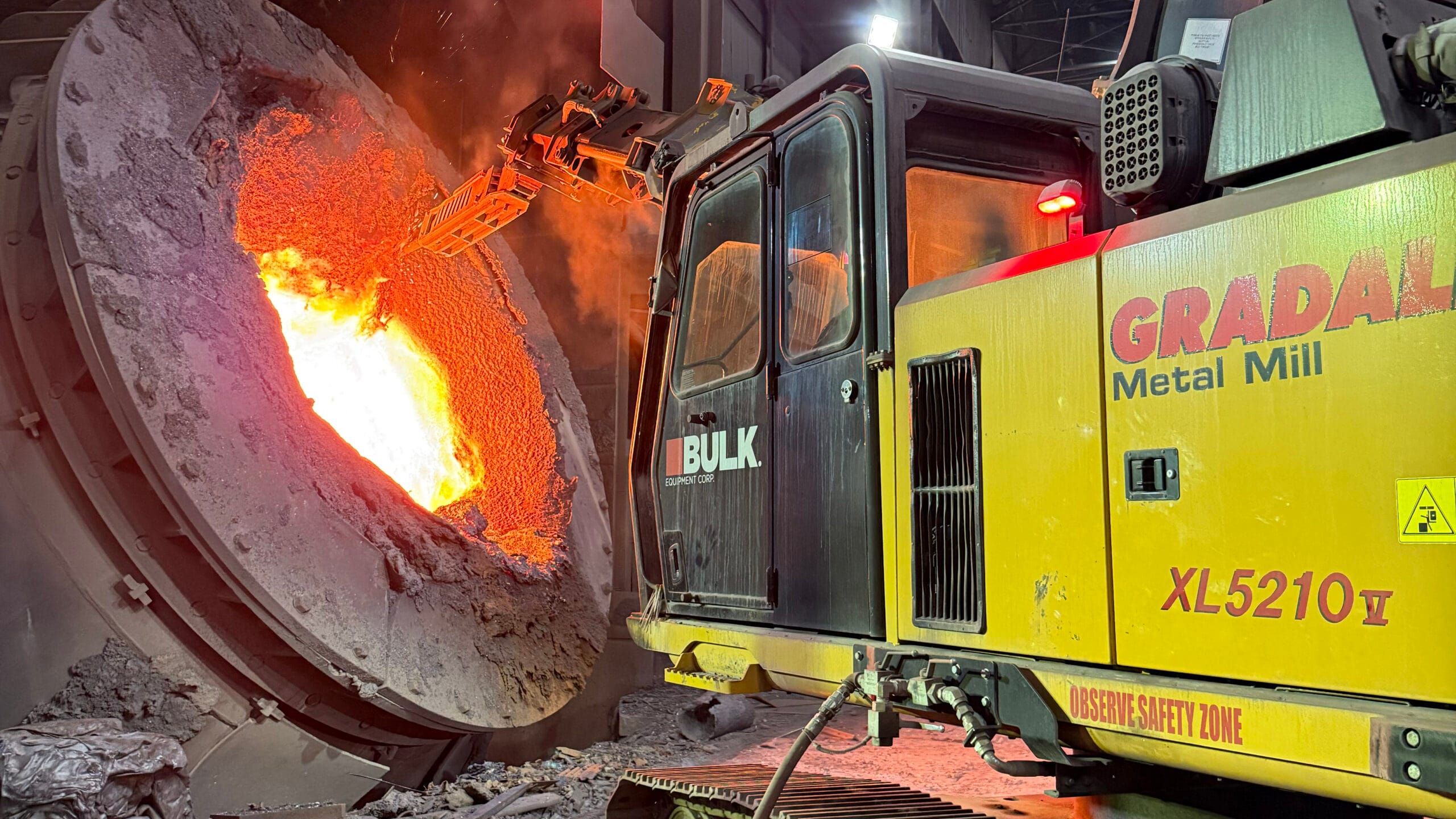
Heavy Equipment Buyer’s Guide
Industrial Tear-Out Machines: How to Compare, Choose, and Keep Operators Out of Harm’s Way
The honest guide to slag, refractory, and scale removal machines for blast furnace, BOF, EAF, and ladle work: Gradall vs LAG vs KT-Grant vs TML, cab versus remote versus top-mount, the attachments that do the work, and what a hammer on an excavator gives up.
Updated September 2026
Download the PDF guideA tear-out machine removes the material a furnace leaves behind: slag buildup, worn refractory, and scale in blast furnaces, basic oxygen furnaces, electric arc furnaces, ladles, torpedo cars, and runners. The work happens on outage deadlines, in tight and hot spaces, with debris coming off the wall, which is why the machine choice comes down to two questions: how do you keep the operator out of the strike zone, and how long does the machine survive the abuse. This guide compares the builders, Gradall, LAG, KT-Grant, and TML, the control configurations, the attachments that do the work, and the ways to get tear-out done without owning the iron at all.
Bulk Equipment Corp is an 80 year old, brand-independent heavy equipment uptime partner headquartered in Michigan City, Indiana, with a shop in Memphis, Tennessee. We sell and service Gradall mill maintenance machines, run our own remote-controlled and cab-operated tear-out fleet, and perform industrial tear-out as a service for mills and mill service contractors.
DefinitionWhat Is an Industrial Tear-Out Machine?
A tear-out machine is a track machine and a demolition tool matched to vessel work: a boom or arm that reaches into a furnace, ladle, or runner, and a hammer or tool that breaks slag buildup, refractory, and scale off the walls and floor. The track machine can be a purpose-built melt shop maintenance machine, a remote-controlled machine, or a modified excavator, and the operator can sit in a protected cab or stand completely outside the vessel with a remote. What separates tear-out iron from general demolition iron is the environment: residual heat, abrasive dust, confined access, and material that falls without warning.
Typical work runs across integrated steel mills and electric arc furnace shops alike: blast furnace runner and trough breakout, basic oxygen furnace (BOF) mouth descull and taphole changeout, torpedo car cleaning, electric arc furnace (EAF) lining removal, ladle cleanout and wall cleaning, slag buildup on runners and vessel lips, taphole drilling, scale and skull removal, and outage cleanup when every hour of the schedule is spoken for.
Boundary notes: hauling molten slag away from the furnace is slag pot carrier work (including the newer dump-box movers covered in that guide), and moving coils and slabs belongs to heavy-capacity forklifts and industrial transporters. This page is about the machines that tear material out.
Does tear-out differ between an integrated mill and an EAF shop?
The machine classes are the same; the vessels and the heat are not. An integrated steel mill makes iron in a blast furnace and converts it to steel in a basic oxygen furnace, so tear-out runs through the cast house (runner and trough breakout and cleaning), the torpedo cars that carry hot metal, the BOF (mouth descull, taphole changeout, and lining tear-out at reline), and the ladles. More of that work happens near molten iron and steel, which pushes integrated mills toward remote-controlled machines and pneumatic hammers for the hot work. An electric arc furnace shop concentrates the work on the EAF lining at reline, the slag door, and ladle refractory. Every builder on this page publishes BOF and electric furnace applications, LAG and TML publish blast furnace runner work as well, and the decision questions further down apply to both kinds of mill.
What do melt shops actually optimize for?
Talk to the people who run tear-out in a steel or aluminum mill and the priorities are consistent. Every machine decision on this page traces back to one of these:
- No delays. Downtime during the tear-out pushes the schedule and reduces the number of heats in that 24-hour period. The machine that keeps the outage on schedule wins.
- Reliability first, speed second. Efficient does not always mean fast; it means the job finishes without surprises.
- Torque. Taphole drilling and heavy tear-out are torque problems. A machine that cannot turn the tool through the material is the wrong machine.
- Space. The vessel and the aisle decide the machine size before the spec sheet does.
- People out of the vessel. When nobody should be near the work, remote operation is the answer, not a braver operator.
The SplitCab-Operated, Remote-Controlled, or Top-Mount: Which Do You Need?
The first decision is not the brand; it is where the operator is and where the machine sits. Cab machines win on production, visibility, and long shifts. Remote machines take the operator out of the danger zone entirely, which is the only acceptable answer in areas that might be holding molten iron and steel. Top-mount furnace machines work from above the furnace for dross and cleaning duty. Serious tear-out programs usually end up with more than one answer.
| Cab-operated | Remote-controlled | Top-mount furnace machines | |
|---|---|---|---|
| Operator position | Enclosed, elevated cab with heat-resistant glass and HVAC | Outside the danger zone with a radio remote transmitter or umbilical cord | Machine mounts above the furnace; operator runs it remotely or from a station |
| Where it wins | Long shifts, travel between vessels, visibility, production | Areas that may hold molten iron and steel, unstable lining, confined vessels | Furnace wall, hearth, and dross work from above the mouth |
| Example machines | Gradall XL series | LAG 2800 and 3400, KT-Grant GOM and KT-30R, and optional remote-configured Gradall units | LAG 4500 and KT-Grant furnace tending machines |
| Safety systems | Heat shielding, guarded glass, fire-sleeved hoses | Detection zones that slow and stop the boom near personnel | Operator never enters the furnace area |
The detection point is not theoretical. On a LAG machine, AI cameras watch defined zones around the machine: when a person enters a zone the boom slows, and it stops before it ever comes within an arm’s length of contact. We covered a real tear-out boom-strike injury and how that system makes it an impossibility in the safety article below.
Which machine classes do tear-out?
Purpose-built melt shop maintenance machines take the heavy, hot, repeated work; remote machines take the tightest and highest-risk spaces; and modified excavators cover open-area outage demolition where access allows.
| Class | Operator position | Where it wins | Where another class fits better |
|---|---|---|---|
| Purpose-built melt shop maintenance machine | Protected cab or remote | Repeated furnace and ladle work; boom geometry made for vessels; built for mill duty from the factory | Needs the aisle and vessel access for a full-size machine; where it cannot fit, a remote machine takes over |
| Remote-controlled machine | Standing away from the vessel | Confined vessels, high strike-zone risk, still-hot refractory | When the footprint allows it, a larger machine like a Gradall greatly enhances production on heavy buildup |
| Excavator with hydraulic hammer | Cab at the machine | Open-area demolition and big buildup where reach and hammer energy matter | Access: the machine often cannot fit into the parts of the melt shop where the work is, and standard machines wear out fast in mill duty without heat and dust protection |
The ComparisonGradall vs. LAG vs. KT-Grant: Who Builds Tear-Out Machines?
Four builders lead purpose-built tear-out machinery for North American melt shops. Here is the field, honestly.
| Spec | Gradall | LAG | KT-Grant | TML |
|---|---|---|---|---|
| Line and models | XL 3210 to 7210 V crawler; XL 3310 to 7310 V wheeled; XL 4240/4340 V aluminum | LAG 1400 pedestal; LAG 2800 non-elevated and 3400 elevated crawlers; LAG 4500 top-mount furnace machine | GOM-360 series, KT-30R Series II, ladle skimmers, slag door pushers, furnace tending machines | UNIDACHS telescopic rotary-boom machines; ladle cleaning, taphole drilling, and deslagging machines |
| Control | Cab with electronic joysticks; remote configurations available | Radio remote transmitter or umbilical; the 1400 adds pedestal and pulpit consoles | Wireless and tethered remote systems | Radio remote standard; cab configurations available |
| Boom | Telescoping to 52 ft with 360 degree continuous tilt | Telescopic, 10 ft stroke, 352 degree rotate, tools pivot to 90 degrees down | Double-pivot low-profile design built for impact hammering | Telescopic boom with rotary head for working through vessel openings |
| Known for | Size, weight, and durability; the machine for repeated heavy duty when space allows | Torque for taphole drilling and hard tear-out; custom builds to the vessel; pedestrian detection system to prevent struck-by incidents | Remote-control heritage since 1951; custom builds to the vessel | Debricking specialization; claims the largest installed base of mobile debricking machines worldwide |
| Power | Volvo Stage 5 diesel; ZF driveline; Rexroth drive motor | John Deere Final Tier 4 diesel, 139 hp | Diesel or electric options published on GOM series | Deutz Stage V diesel; electric drive option |
| Applications published | Ladle, BOF, taphole, electric furnace, torpedo car, dross skimming; slag door and descaling work where the footprint permits | Torpedo car, ladle, taphole, BOF, electric and blast furnaces, dross, slag door maintenance, descaling | Refractory removal, BOF taphole changeout, ladle, EAF slag door, descaling | BOF, EAF, and ladle debricking, hot debricking after the last heat, taphole drilling, converter mouth cleaning |
The Purpose-Built Option
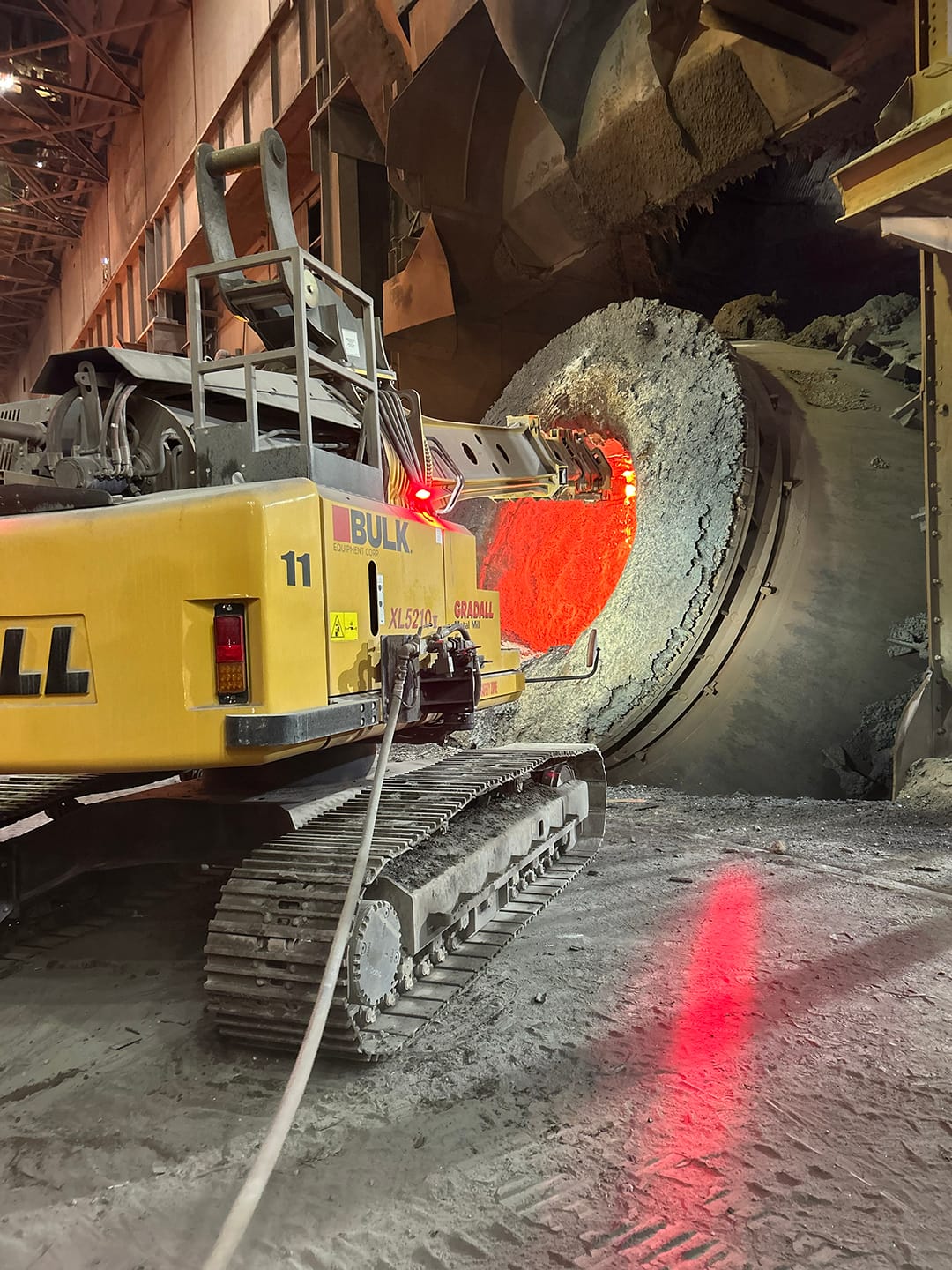
Gradall mill maintenance machines
Gradall builds steel mill and aluminum mill maintenance machines specifically for furnace, ladle, and tear-out work. The telescoping boom carries hammers and tools into the vessel, and the machine is built for mill duty from the factory instead of adapted to it afterward. Bulk sells and services them.
Not sure which machine fits your vessels?
Tell us the vessels, the buildup, and the access, and we spec the machine and attachments against them. No runaround.
See It WorkWhat Does Tear-Out Actually Look Like?
These clips are from our own machines and service work: remote operation keeping the operator away from molten iron and steel, the LAG detection system, and the hydraulics that decide how long a machine lasts.
More from the same series: why Rexroth hydraulics keep a tear-out machine out of downtime and configuring one machine for both hydraulic and pneumatic attachments.
AttachmentsWhich Attachment Does Which Tear-Out Job?
The track machine positions the tool; the attachment does the work, and matching it to the material is half the job. The workhorses are the chicken foot, the hammer, and the bucket, with picks and rakes covering the jobs in between. One machine can be configured for both hydraulic and pneumatic attachment circuits, so the same machine swaps between tools on the job.
Chicken foot
- The multi-tine tool for raking and pulling material out of vessels
- Breaks loose buildup free and drags it to where the bucket can take over
- One of the three most common tear-out attachments
Hammer
- Hydraulic and pneumatic breakers do most of the actual demolition
- Pneumatic for high-heat work, hydraulic for cold heavy breaking; sized to the machine and the buildup
- We supply Rammer hydraulic hammers and Furukawa pneumatic hammers
Bucket
- Cleanup and removal once material is broken loose
- Pairs with the hammer on nearly every outage
- The third of the big three attachments
Pick, rake, and taphole drills
- Picks and rakes cover the jobs between breaking and hauling
- Hydraulic taphole drills handle cleanout and replacement
- Custom tooling gets built to the vessel when the catalog does not fit
We stock Rammer hydraulic hammers and attachment parts through Bulk Lift Products.
When do you run a pneumatic hammer instead of a hydraulic hammer?
Heat decides it. A hydraulic hammer carries the machine’s hydraulic oil out to the tool, and at the hot face that oil thins, the seals harden and crack, and a leak near molten iron and steel is a fire risk. Compressed air is unaffected by heat, so a pneumatic hammer can go to work on a ladle, furnace mouth, taphole, slag door, or runner right after the last heat, before the vessel has cooled. That is why high-heat tear-out in steel mills leans on pneumatic hammers, while cold, heavy breaking, where energy per blow matters most, is where hydraulic hammers earn their place. We supply Furukawa pneumatic hammers and Rammer hydraulic hammers, and a mill maintenance machine can carry both circuits, with an onboard oiler feeding the pneumatic line from either side of the machine, so one track machine covers the hot work and the cold work.
DurabilityWhy Durability Decides the Machine
Tear-out duty is a wear test. Hammer BPMs, blows per minute, work on every pin, bushing, and weld. Abrasive dust gets into hydraulics and cooling. Residual heat cooks hoses, glass, and electronics that were never rated for it. A standard excavator put on regular tear-out work ages years in months, which is why purpose-built machines and mill-duty packages exist in the first place.
From the Field
Watch: need a more durable machine for tear-out at the melt shop?
Tear-out at the melt shop wears out standard iron. This clip covers the Gradall mill duty machines built to handle the abuse of the job.
Built for mill dutyGradall steel and aluminum mill maintenance machines carry hammers and tools into furnace, ladle, and tear-out work.
Proven in the dutyThe machine class our own tear-out crews run in melt shops, with the operator kept out of the strike zone.
What fails first on tear-out machines?
- Boom pins and bushings. Hammer BPMs loosen and wear every joint in the boom faster than digging duty ever would.
- Hydraulics. Abrasive dust and heat degrade hoses, seals, and oil; contamination from a hammer circuit spreads through the whole system.
- Cooling and filtration. Fine refractory dust plugs radiators and filters, and an overheating machine on an outage deadline is a schedule problem, not just a repair.
- Glass, guarding, and electronics. Anything not rated for heat and flying debris gets replaced early and often on a standard machine.
Every one of those failure points is repairable, and this is the work our shops and field techs do: rebuilds, welding and line boring on wallowed-out bores, fabrication of guarding, and PM programs matched to the duty. Any brand, whether we sold the machine or not.
Already running tear-out iron? Keep it running.
Brand-independent field service, rebuilds, and PM programs matched to hammer duty, dispatched from regional hotlines.
CostHow Much Does a Tear-Out Machine Cost?
Purpose-built tear-out machines start at approximately $400,000 and range up to approximately $900,000, with machine size and spec deciding where a build lands. No builder in this class publishes list pricing; every machine is quoted to the vessels it will maintain. What moves the number inside that range:
- Machine class and size. A remote-controlled track machine and a full-size melt shop maintenance machine sit in very different brackets.
- Mill-duty protection. Heat packages, guarding, sealed electronics, and upgraded cooling add real money and pay for themselves in machine life.
- Tooling. Hammers, chicken feet, buckets, and taphole drills are their own line item, and tool size must match both the machine and the buildup.
- Utilization and who maintains it. Daily duty with your own operators can be a purchase or a long-term rental where we own and maintain the machine. A few outages a year points to a short-term rental or tear-out as a service.
What does tear-out cost per ton?
Melt shops run their numbers on cost per ton processed, so we get asked for a tear-out cost per ton. We do not publish one, because the machine cost is close to fixed while the tonnage it is spread across is not: the same machine carries a very different cost per ton in a mill making 700,000 tons a year than in a mill making 2 million. Bring us your annual output and outage schedule and we will work the per-ton number with you across purchase, rental, and crew.
Want a real number instead of a range?
Tell us the vessel, the buildup, and how many outages a year, and we will quote the machine, the rental, or the crew.
OwnershipOwn the Machine, Rent It, or Hire the Work Done?
Tear-out is unusual among equipment classes because owning the machine is only one of three ways to get the work done. The right answer follows two questions, how often the machine runs and who you want maintaining it, and every path below is one we actually run.
Buy the machine
Makes sense when tear-out is regular, scheduled work at your site.
- Gradall mill maintenance machines, new and used
- Spec’d to your vessels and tooling
- Backed by brand-independent field service
Rent the machine
Makes sense when you want your own operators running tear-out but do not want to own and maintain mobile equipment. Daily duty and outage windows both fit.
- Machine and tooling, short-term or long-term
- Maintenance stays with Bulk, not your maintenance department
- Backup depth if a unit goes down mid-outage
Hire the crew
Bulk performs industrial tear-out as a service: our machines, our operators, your outage schedule.
- Remote-controlled and cab-operated fleet
- Operators stay out of the strike zone
- Safety record and hours available on request
Rather not put your people near the strike zone at all?
Our tear-out crews bring the machines, the operators, and a safety record we share with every quote.
The DecisionHow Do You Choose a Tear-Out Machine?
Work through these in order and the answer usually falls out:
- What vessel are you servicing, and what is the access? Servicing covers tear-out, refractory, taphole, and scaling work, and the opening size, floor condition, and reach rule machine classes in or out before anything else.
- How hard is the material, and how much torque does it take? Slag buildup, worn brick, skull, and taphole work each ask for different tool energy and torque, which sizes the track machine.
- Where does the operator need to be? If the honest answer is nowhere near this, you are choosing between a remote machine and hiring a crew that runs one.
- How many hours a year will it run, and who maintains it? Regular duty justifies a purpose-built machine, owned or rented long-term with the maintenance carried by us. A few outages a year points to a short-term rental or tear-out as a service.
By IndustryWhere Tear-Out Machines Earn Their Keep
Integrated Steel Mills: Blast Furnace and BOF
- Blast furnace cast house: runner and trough breakout and cleaning
- Basic oxygen furnace mouth descull, taphole changeout, and lining tear-out at reline
- Torpedo car and hot metal ladle skull and slag removal
Electric Arc Furnace Mills
- EAF hearth and sidewall lining removal at reline
- Slag door cleanup and slag work below the furnace
- Ladle cleanout, wall cleaning, and debrick with minimum metal loss
Aluminum
- Dross skimming through the furnace mouth
- Furnace wall and bottom maintenance
- Pot cleaning and furnace teardowns
Cement, Lime, and Process
- Kiln and vessel refractory removal
- Scale and buildup removal without personnel entry
- Descaling in confined vessels
Foundries run the same relining and cleanout work at a smaller scale, and tear-out machines work alongside the rest of the mill fleet. See the Metals Production and Mill Services industry guides, or browse all equipment.
AnswersFrequently Asked Questions
What is an industrial tear-out machine?
A tear-out machine is a track machine and demolition tool matched to vessel work: it reaches into furnaces, ladles, and runners and breaks out slag buildup, worn refractory, and scale. The main classes are purpose-built melt shop maintenance machines, remote-controlled machines, and excavators fitted with hydraulic hammers.
Who builds industrial tear-out machines?
The field serving North American melt shops is Gradall (XL series machines), LAG Equipment (remote-controlled and top-mount machines with a pedestrian detection system), KT-Grant (remote machines and custom builds, since 1951), and TML (UNIDACHS debricking machines). Compact demolition robots serve the confined-space end of the market.
Cab-operated or remote-controlled: which do I need?
Cab machines win on production, visibility, and long shifts. Remote-controlled machines take the operator out of the danger zone entirely, which is the only acceptable answer in areas that might be holding molten iron and steel. Top-mount furnace machines cover dross and wall work from above the furnace. Serious tear-out programs usually run more than one.
Do tear-out machines work in integrated mills with blast furnaces and BOFs?
Yes. The same purpose-built and remote-controlled classes serve integrated mills and EAF shops. In an integrated mill the work runs through the blast furnace cast house (runner and trough breakout), the torpedo cars, the basic oxygen furnace (mouth descull, taphole changeout, and lining tear-out at reline), and the ladles, with more of it done near molten iron and steel, which favors remote operation and pneumatic tooling.
What machine removes refractory from a ladle?
Ladle refractory is usually removed with a melt shop maintenance machine or a remote-controlled machine running a hydraulic hammer. The confined space and falling-material risk make remote operation attractive, because the operator stands completely outside the vessel while the tool works.
Can I use an excavator with a hammer for mill tear-out?
For occasional light demolition, yes. For vessel work, a standard excavator gives up the boom geometry, the heat-protected hydraulics and glass, and the operator protection that purpose-built machines provide, it often cannot fit into the parts of the melt shop where the work is, and it ages years in months on regular mill duty. Compact demolition robots cover confined light work; purpose-built machines cover the rest.
What attachments do tear-out machines run?
The three most common are the chicken foot, the hammer, and the bucket, with picks, rakes, and hydraulic taphole drills covering the jobs in between. We supply Rammer hydraulic hammers and Furukawa pneumatic hammers, and machines can be configured with both hydraulic and pneumatic circuits so one machine swaps between tools.
Why are pneumatic hammers used for high-heat tear-out?
Compressed air is unaffected by heat, while hydraulic oil thins and hydraulic seals harden and crack at the hot face. A pneumatic hammer can work a ladle, furnace mouth, taphole, or runner right after the last heat, so high-heat tear-out in steel mills leans on pneumatic hammers and cold, heavy breaking leans on hydraulic hammers. One machine can carry both circuits.
How much does a tear-out machine cost?
Purpose-built tear-out machines start at approximately $400,000 and range up to approximately $900,000 depending on size and spec. No builder in this class publishes list pricing, so every machine is quoted to the vessels it will maintain. Tell us the vessel and the duty and we will give you real numbers for the machine, the rental, or the crew.
Can I rent a tear-out machine instead of buying one?
Yes, short-term for an outage or long-term for daily duty. Renting fits when you want your own operators running the work but do not want to own and maintain mobile equipment: the machine and tooling come from Bulk and the maintenance stays with Bulk. Tell us the vessel and the hours and we will quote purchase, rental, and crew side by side.
Who does the tear-out if we do not want to own a machine?
Bulk performs industrial tear-out as a service: remote-controlled and cab-operated machines, our operators, on your outage schedule. Ask for the current safety record and hours; we track both and share them with every quote.
Want this guide as a PDF?
Download the print version to share with your maintenance, safety, and purchasing team.
Talk to UsTell Us the Vessel. We Spec the Machine or Bring the Crew.
We sell, rent, and service tear-out machines, and we run our own tear-out crews, so the recommendation you get is based on your vessels and outage schedule, not our inventory. If you are after a machine, use the equipment form; if you want the tear-out done for you, use the services form.
Buying or renting a tear-out machine
Need tear-out done for you